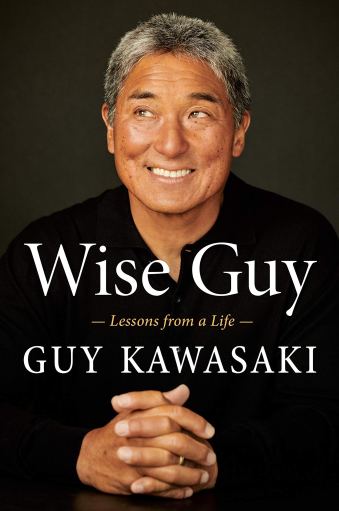
Wise Guy by Guy Kawasaki

Wise Guy
We called it the $30,000 hockey jersey.

I was helping organize a speaker series at the University of Oregon, and we wanted to invite Guy Kawasaki to speak. We had a generous, but limited budget, but when I saw that his speaking agent was a U of O alum, I figured it would be no problem. So I emailed her and asked her about having Mr. Kawasaki speak. She said she’d be delighted to help arrange it, and told me his speaker fee. I gulped. That was many times our budget, and I knew we could not meet that fee.

At the time, I was in the middle of reading Enchantment, Kawaskai’s book about persuasion and how to get people to do what you wanted them to do. Over the weekend, I finished reading it, and in the very last chapters, Kawasaki explained how to get somebody -like him – to open and read your emails, especially if you wanted them to do something for you. He also included his email address! I was amazed, and skeptical, but figured it was worth a try.

First, I spent a few hours reading his blog and social media posts. I learned that he was a huge fan of hockey, of good design, and had recently visited Oregon and had raved about the track and field tradition that had resulted in Phil Knight starting Nike with his track coach Bill Bowerman. I knew a few people involved with track and field, and knew one of Nike’s top designers. I also noted that he had a blog called Holy Kaw! (and there was a restaurant on campus called “Holy Cow” and he’d noticed it on his visit.)

Here’s (as best as I can recall) the email:

TO: GUY KAWASAKI

SUBJECT: Come speak at UO and we’ll get you tickets to the sold out Olympic Trials

Dear Mr. Kawasaki,

We would like you to come speak at the UO, if you agree, we will introduce you to the designer of the O, provide a set of tickets for you and your family to attend the Olympic Trials for Track & Field that will be held here this summer, and ask the place in the student union to correct the spelling of their name for your visit – Holy Kaw!

Our budget is a tad  (actually, a whole lot) less than your usual fee, but we are wondering: Would you please consider speaking here next spring?

Within 20 minutes, I had an email back.  It said simply:

Sure.  I’ll do it.

A few weeks later, his agent set up a phone call for us to work out all the final logistics. I asked him how many tickets he wanted to the Trials. He said: “w\Well, I’m not sure we can go to the meet, but what I really want is one of the UO hockey jerseys.”

Wow. I thought. That’s easy.

Of course, it wasn’t quite as easy as I expected. The hockey team had special jerseys that couldn’t be purchased anywhere. But when I called their coach and explained our dilemma, he had an idea: “We often give the jersey as a gift to the donors who support our program. Maybe you could do that?”  Done!

Guy (he told me I could call him that) spoke on campus, to a standing ovation, and we kept in touch over the next few years. He’d call whenever he was in town, and we’d try to get lunch or dinner. He even sent me a photo of him skating at Notre Dame in his Oregon hockey jersey.

When I saw Wise Guy, I immediately picked it up. It is a book of stories and advice and, from my experience, sincerely Guy. He shares what wisdom he has learned over his 60+ years, and tells some great stories as he goes. Nothing too complicated. Nothing too deep or even exceptional – just simple wisdom from somebody who has written 14 books and flies all over the world giving speeches – for, I imagine, a lot more than a hockey jersey.

The final chapter is written by his children and some friends who tell their “classic Guy” stories. I was heartened to read that my experience with him was not an exception – it was just another version of the many ways Guy Kawasaki has delighted people who have had the pleasure of crossing his path.

Go read his book if you don’t believe me.


Praying for Sheetrock by Melissa Fay Greene

Praying for SheetrockSometimes when I read a book, for years after, I remember the story. With others, it is simply a sentence that I recall even when I can’t remember the whole (or even  a part) of the rest of the book. The God of Small Things by Arundhati Roy is like that for me – I have only a vague recollection of the story, but I always remember the lyrical language (“Rahel drifted into marriage like a passenger drifts towards an unoccupied chair in an airport lounge.”)

In Praying for Sheetrock, it is a sentence in the prologue: “The McIntosh County Volunteer Fire Department truck arrived first, unfurling a long red scarf of sound on the county roads behind it.” I always think of that red scarf of sound whenever I see a fire truck. It is such a perfect sentence. And it evokes the time and the place and the feeling of the night when the story begins (though, it is not the beginning of the story.)

Melissa Greene’s lyrical language pulls you in to a county in south Georgia at the beginning of the civil rights movement – though they did not know it was the beginning until long after. It is “a chronicle of large and important things happening in a very little place. It is about the end of the good old boy era and the rise of civil rights, and what that famous epoch looked like, sounded like, smelled like, and felt like in a Georgia backwater in the 1970s.”

I loved this book the first time I read it and have gone back to read parts of it over the years. It has a special place on my bookshelf because a dear friend sent me a copy as a gift with a card inside that said “those of us who spend our lives tilting at windmills must read this book.”

He was right.  It made me wish I had been born earlier so that I would have been old enough to have lived through the Civil Rights Movement as an adult — I would hope that I would have been there as a Freedom Rider…. and I always appreciated the small details described. Reading this book, I felt like I might be able to really understand something that was, before, unfathomable: the racist actions of small time Southerners against their neighbors and colleagues and classmates. I felt like I got a glimpse into the lives of people I could never have known and I came away richer for it.

It is rare that one book has so much impact on one’s life – but Praying for Sheetrock did for me. If I had not read and loved it, I would not have sought out Melissa’s other writing and I would never have gone to Ethiopia, never met my daughters, never gotten so engaged in the very civil rights work that Praying for Sheetrock introduced me to way back when. I read this book the first time when I was ‘tilting at windmills’ doing death penalty work in Texas, but it remains a touchstone for me when I think about how individuals can, and do, send out what Robert F. Kennedy described as a “tiny ripple of hope” like the African Americans in McIntosh County Melissa writes about did.

UPDATE: As I’ve described before, Melissa Fay Greene would literally change the direction of my life. Her article in the New York Times Magazine “What Will Become of Africa’s AIDS Orphans” contained this paragraph:

‘This is the most devastating pandemic to sweep the earth for many centuries,” says Dr. Mark Rosenberg, executive director of the Atlanta-based Task Force for Child Survival and Development. He compares the moral imperative to stop the epidemic in Africa, Asia and South America to the era of the Holocaust and imagines that future generations will ask, ”What did you do to help?”

For months I could not get that last sentence out of my mind: What can I do to help? What will I do? I had the pleasure of meeting Ms. Greene and told her how her article had inspired me to try to do something, but I had no idea where to start. “Call Merrily Ripley” she replied. And I did. I ended up spending 4 months volunteering at the orphanage in Addis Ababa, Ethiopia that she ran, where I fell in love with the children and the culture and all of Ethiopia. I ultimately decided to adopt my twin daughters, and also was able to spend time with Melissa as she wrote about the amazing Haregewoin Teferra in “There is No Me Without You“. But none of that would have happened without first reading Praying for Sheetrock.

The Autobiography of an Execution by David Dow

The Autobiography of an Execution is David Dow’s searing memoir of what it is like to be a death penalty attorney.  It is a behind-the-scenes look at what it is really like to represent people on death row. In Texas. While George W. Bush was governor. When dozens of people were executed every year.
It doesn’t get much worse than that…well, except for the part about representing an innocent man and watching him be executed.  That’s definitely the worst.

It’s pretty heavy stuff.  Pretty heady stuff.  And this book would be a Terrible, Horrible, No Good, Very Bad story if it weren’t for Katya and Lincoln, Dow’s wife and son who, in their real-world, real-love way lighten Dow’s load and make his life, and the story, so much better.

Dow shows the sausage making of capital punishment; the “tinkering with the machinery of death” that Supreme Court Justice Harry Blackmun denounced. He displays the racism, the injustice, the absurdity of the byzantine system that exists in Texas.  It is all in the details of the cases described and in Dow’s commentary as he moves between them.

He does it with spare language, with no hyperbole and with an honesty that the rules of ethics limit but don’t diminish.  Having been there, done that, I can say without doubt that this book is True (with a capital T). It is accurate. It is real. And it is sad beyond measure.

I almost didn’t read The Autobiography of an Execution because I knew that it would give me nightmares, would remind me of the dark days of the work that I used to do. But when I was finished, I was glad that I read it. I found that it renewed my commitment to the abolition of capital punishment. It showed how a small spark of humanity sometimes comes from an unlikely source. And it reminded me why I so deeply respect those few, brave souls who make it their life work to represent the unrepresentable, speak the unspeakable, fight to preserve life — even of those who have taken life.

UPDATE: When I first wrote this review, I was not engaged in death penalty work. I am again, though in a very different (pre-trial) realm.  Reading this book some 5 or 6 years ago made me realize I could do it again, and for that I am deeply grateful. David has branched out into writing fiction (in his “spare time” while he teaches law, runs a death penalty clinic, and continues to represent clients. Not sure when he sleeps!) He is also the founder of the Texas Innocent Network. His first novel, Confessions of an Innocent Man will be published in April. I can’t wait to read (and review) it!

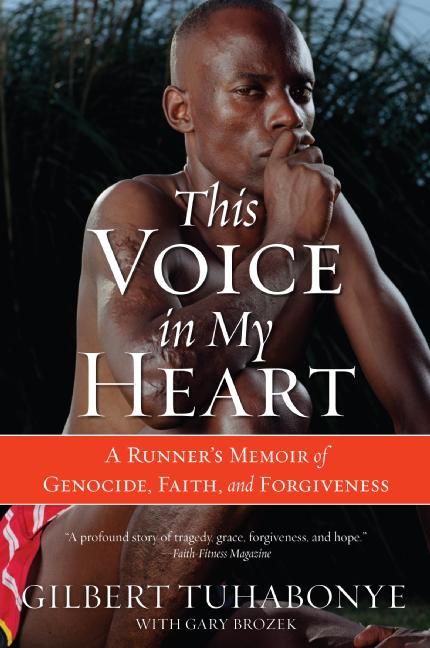
This Voice in My Heart: A Genocide Survivor’s Story of Escape, Faith and Forgiveness by Gilbert Tuhabonye

Image result for This Voice in My HeartThe story of genocide is left to be told by the scarred souls who survive it.  Scarred by fire, Gilbert Tuhabonye tells a story of evil so vast as to be incomprehensible – except perhaps in snippets.

In This Voice in My  Heart:  A Genocide Survivor’s Story of Escape, Faith and Forgiveness, Tuhabonye separates his story of the 1993 genocide in  Burundi into snippets.  Interspersed and italicized between the story of his life growing up in a small village in Burundi, these snippets allow us to absorb the story — without turning away in horror.  But horrific it was, that day in October 1993, when Hutu neighbors butchered and burned Tuhabonye’s Tutsi classmates, teachers and friends.  Tuhabonye alone survived the attack after breaking a window with a charred femur, avoiding a crowd of murderers and running through the woods with his skin aflame.

Tuhabonye survived, he believes, in order to tell the story. The “voice in his heart” spoke to him through the horrors, telling him that he would survive so that he could bear witness. That voice, Tuhabonye believes, was God, speaking strength, saving his life, and imbuing his days with new meaning.

Switching between the horrific and the mundane, This Voice in My Heart has a rhythm, a pace, a melody, that draws you in. A morbid fascination with the acts of ordinary citizens gone feral is balanced against daily life in a place with limited electricity, water drawn from a well, and no indoor plumbing. You learn how running – the discipline, the ability to endure pain, and ultimately the opportunities for travel – played a powerful role in Tuhabonye’s life (including bringing him to Austin, Texas where he now lives and coaches other runners). You also learn how the massacre strengthened Tuhabonye’s faith, and how that faith has become the central tenet of his life. About how, after surviving the holocaust, Tuhabonye runs through life to tell his tale.

I have the great privilege of knowing Gilbert, and had the even greater privilege of getting to witness the telling of his tale and write about it. It is a story that still haunts me.

This Voice in My Heart contains a photograph of a monument on the site of the massacre. It reads “Never Happen Again.” In the face of the mass killings in Darfur, in Syria, in Yemen, it is hard not to be cynical about such sentiments. Yet after reading Tuhabonye’s story, told without rancor, one is led to have faith that in hope there is the possibility of redemption.

UPDATE: Gilbert still runs. He still coaches other runners. And his mantra is: Run with Joy. On the one hand, knowing his history, I wonder – how can he run with joy? And, yet, on the other, hand, how can he not run with joy?  Gilbert has also started a charity, the Gazelle Foundation, that helps to provide clean water to the villages in Burundi near where he grew up. He has combined his love of running to fund the wells and clean water by organizing the Run for the Water event every fall in Austin, and also raises funding for the water projects through a Spring for the Water Gala. If you can’t attend either event, you can still support the important work that the Gazelle Foundation is doing. Sometimes we think one person can’t make much of a difference in our world. Gilbert’s life choices show just how wrong such thinking is.


The Grace of Silence by Michele Norris

The Grace of SilenceI read The Grace of Silence: A Family Memoir long before I met the author Michele Norris. I had always enjoyed her voice on NPR’s All Things Considered where she was a host and then later a ‘special correspondent.’  I loved the quality and timbre of her voice on the radio – but I also loved the voice she brought to the stories she reported. It was always a perfect combination of professional and personal, serious and appropriately lighthearted. I was thrilled when I heard she had written a book, and read it soon after it was published.

Three years later, in the fall of 2013 I had the privilege of helping to host Ms. Norris when she visited the University of Oregon as we participated in The Race Card Project. So again, I read The Grace of Silence, and it became a much richer read the second time around.

The book is something simple – a memoir of a family, Michele Norris’ family. It is the story of how they have navigated the world through the past generations. But it is so much more complex than that. It is a history lesson and parenting classes. It is a personal journey and a universal experience. It is a true-detective story and an exploration of race in America. And, most importantly, it is full of Grace. Not merely the dictionary definition of grace as “a disposition to kindness and compassion;” The Grace of Silence evokes the life lesson “that Grace is also measured by how you climb up on the rough side of a mountain and what you do with your life once you get there.” That is the Grace explored within the books’ pages.

I’ve thought a lot about the title – wondering how Ms. Norris came to find grace within silence. She originally began the project as a way to explore race in America in the months after Barack Obama was elected President. She then realized she first had to understand her personal history and her family’s experience of race in order to better understand the larger context. As she focused her extraordinary reporting skills on uncovering the truths of her own family, she learned much of ‘things left unsaid.’ So many pieces of her family’s history just weren’t talked about. At times, you can almost feel on the page the frustration of a child learning things for the first time (as an adult) such as the fact her father had been shot by the police when he was a young man, just after he returned from serving his country in World War II.

And I had to wonder – where’s the grace in that bit of silence?

As I was pondering that question, my dear friend Naomi Kirtner posted something on Facebook that shed light on it for me.

She wrote:

In the last portion of the Torah, there is a strange reference to eish da’at, “the fiery law.” The Midrashim (the interpretive texts) suggest that the Torah was written with “black fire on white fire.” The literal letters of the Torah are the black fire, and they rest upon the foundation of the white fire. The whole of Torah can be fully understood and interpreted only through the relationship between the two.

It seems to me that’s it. The whole of Ms. Norris’ family’s story, the whole of their experience, can only be fully understood through the relationship of what happened and what was revealed about it, and what was not. Of actions and inaction. Through words and silence. That, it seems to me, is the grace of the sometimes-frustrating silence. Only by seeking to understand both the ‘black fire’ and the ‘white fire’ can we truly understand the history of race in our country. Only by listening to the stories told, and seeking out the stories never shared, can we understand the whole of it (of anything!)

As Naomi went on to explain: It certainly is easy to fall into the trap of thinking that the black fire is the full meaning–that everything you need to know to gain understanding is in the letters we see on the page. It is so much harder to look at a page and see the negative space–to see the pattern created by absence. And yet…that hidden aspect, the omissions, the space between–commentaries on the Torah say that one informs the other in a living relationship and that both are of equal importance.

What happened in and to Ms. Norris’ family is one of many examples of the dichotomy of race relations in America. And so we are incredibly blessed that she shared her explorations of her family’s history with us because it gives a gateway to explore the ‘black fire’ and the ‘white fire’ of race, the civil rights movement, the election of an African American President; the sound and the fury of those events.

Perhaps the grace of the silence is what sustains the exploration; the silence is ‘of equal importance.’ What is said, the stories that are told, is critical to understanding our history. But so are the stories not told. And that is the exquisite beauty of this book – the telling of those untold stories.

UPDATE:

As I post this today, in 2019, The Race Card Project is still going strong. Ms. Norris curates the six-word stories and continues to travel around the country holding listening sessions and reporting on issues of race. I also post this today, on the five year anniversary of one of the last days of Talia Goldenberg’s life; her death was the context for her mother Naomi Kirtner’s comments regarding eish da’at. Talia is still absent. The space created by her absence still is of great importance. Her story, her family’s story, like Ms. Norris’ family memoir is filled with silence. And I still wonder, what is the grace of that silence?

We Should All Be Feminists by Chimamanda Adichie

we-should-all-be-feministsThis will be a short review because We Should all be Feminists is a very short book. In fact, it really is not a traditional book at all but rather an edited version of a speech that Chimamanda Adichie gave at a TEDx event that her brother put on in Euston in 2011. The video is powerful and you should watch it. The book, I might suggest, is better — but only because you can read and re-read it and find your favorite passages and highlight them or read them out loud. Or, perhaps, read them to your daughter or your son or your partner or your boss. Because, as the title implies, we should ALL read this book. But, before you read this book, go watch the TED Talk that made Chimamanda famous: The Danger of A Single Story It’s a TED Talk that’s been watched more than 10 million times. It’s a lesson that needs to be heard at least 10 million more times. And, it lays the foundation for this book, this later TEDx Talk.

We Should All Be Feminists contains a bevy of vignettes. Small slights that Chimamanada has experienced, that her friends have experienced. And, like racial micro-aggressions, these slights are not often spoken about. “Gender is not an easy conversation to have. It makes people uncomfortable, sometimes even irritable. Both men and women are resistant to talk about gender, or are quick to dismiss the problems of gender. Because thinking of changing the status quo is always uncomfortable.” Think about that. And replace the word ‘gender’ with the word ‘race’ It is still a true statement. And it made me think about how much greater a burden women of color have because we don’t talk about gender and we don’t talk about race and we surely, surely don’t talk about race and gender together.   Chimamanda argues that we all must have these conversations. We must have them with our daughters, and more importantly with our sons. As Chimamanda closes her short book: “My own definition of a feminist is a man or a woman who says, yes, there’s a problem with gender as it is today and we must fix it, we must do better. All of us, women and men, must do better.” Amen Sister. Amen.

UPDATE: I think we don’t talk enough about the impact of gender on our political reality in America, and the next election is going to force us to do so; four women have already declared that they are running for president, and it is likely there will be more by the time the primaries start early next year. The lessons of We Should All Be Feminists could be, should be a blueprint for how we approach the issue of gender in the election cycle.

 Kafka Comes to America: Fighting for Justice in the War on Terror by Steve Wax

kafka-comes-to-americaAs a criminal defense attorney, there is nothing scarier than knowing your client is innocent. Especially in a case where the government might seek the death penalty. Few people have experienced that special form of horror – Steve Wax did. Twice. Within a period of less than four years. And (spoiler alert) both of his clients ultimately walked free despite being persecuted and prosecuted by a government caught up in the post-9/11 zealotry that ensnared far too many innocent people both at home and abroad.
In the dual narrative of Kafka Comes to America: Fighting for Justice in the War on Terror – A Public Defender’s Inside Account, Wax tells the story of Brandon Mayfield, an attorney in Portland, Oregon who is arrested as a ‘material witness’ after an FBI agent erroneously identifies his fingerprint as a match for one found on a bag associated with a terrorist bombing of trains in Madrid, Spain. Mayfield’s home is searched surreptitiously, his computers and client files are confiscated, his family left terrified as he spends more than two weeks in jail – not accused of a crime, but held as a victim in the Bush Administration’s “war on terror.”


While what happened to Mayfield, an American citizen, was horrible, the other story that Wax tells is almost unimaginable. Adel Hamad was a humanitarian hospital administrator from Sudan who, along with his wife and four daughters, had been living and working in Pakistan when he was seized by U. S. government operatives. He spent years in custody, first in Afghanistan, then in Guantánamo, and was never told why he was being held. Hamad suffered through dozens of interrogations and was held in isolation with no contact with his family, or anybody outside of Guantánamo. Although he did not suffer the physical torture that many other Guantánamo detainees did, he was, nonetheless, tortured by our government’s actions. Years of the unknown – courts that never ruled on anything, held in a prison that existed to hold people indefinitely, with neither charge nor trial. The details of Guantánamo are chilling – and should give every American pause: in Guantánamo, our government has abandoned its constitutional underpinnings in a way that we may never recover from.

Steve Wax tells the stories of his representation of Brandon Mayfield and Adel Hamad with clarity and insight. He never overstates the case – but never lets the government off the hook for their misconduct. Wax also describes with remarkable accuracy the life of a public defender fighting to preserve the rule of law in a Kafka-esque environment. It is chilling in its accuracy and yet heartening in the passion displayed.

It would be easy to read this book and suggest that it is a less complicated story because the clients Wax writes about are innocent. And that is, to some extent, true. It is easier to be outraged at the government’s misconduct when the client is innocent. But Wax built a career ensuring that not only the innocent received his most vigorous defense, but, that all of his clients did. I got to see that first hand during the almost five years I worked for him as an Assistant Federal Public Defender. His commitment to the rule of law permeated everything he did and everything he taught to those of us luckily enough to work with him. As he states in Kafka: “We want to heed the call to action implicit” in Dr. King’s letter from the Birmingham jail: “Injustice anywhere is a threat to justice everywhere.”

Wax goes further: “The need for compassion and desire to fight injustice were huge before 9/11. They are more needed now.” Kafka Comes to America is an eloquent explanation of why.

UPDATE: When I first read Kafka Comes to America some four years ago, I had no idea how Guantánamo would become a daily part of my life. The Alice in Wonderland-esque quality of Guantánamo has not changed. Although there are fewer men there today than when Wax was visiting, there are still more than two dozen who are being held without charges, including five who have been deemed — by people in the national security/intelligence community whose job it is to keep us all safe from terrorism — as safe for release, but have not been, more than two years after that determination. It is a horrific tragedy for them and for their families. And it is a tragedy of the failure of our so-called justice system.

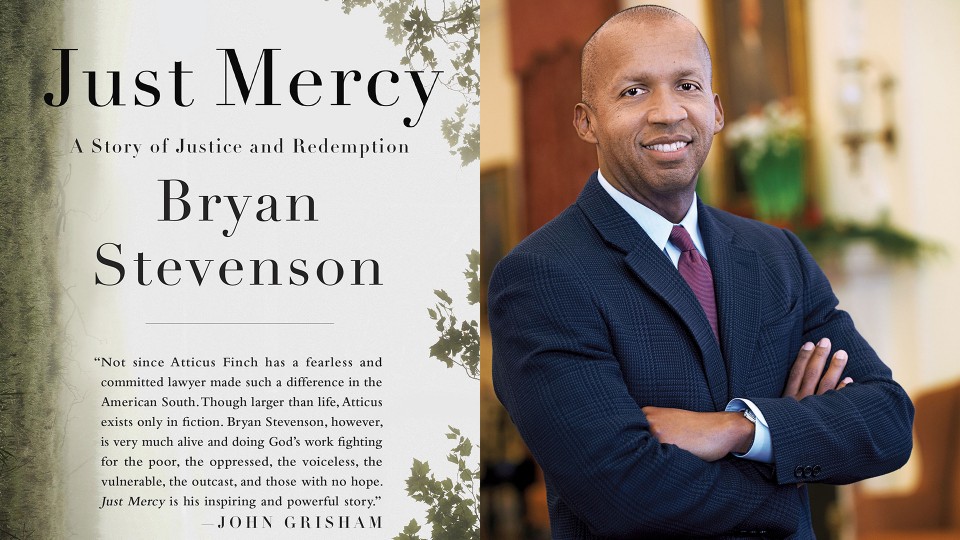
Just Mercy by Bryan Stevenson

just_mercy_stevenson_bryan_002-1Bryan Stevenson has been –and continues to be – a personal role model, a hero and an inspiration, ever since the first time I heard him speak twenty-five years ago. I later had the pleasure of  collaborating with him on national agenda issues when I was doing death penalty work in Texas; we endeavored to put monkey-wrenches into ‘the machinery of death‘ back when executions were not a rarity, when nobody had funding, when Alabama was awful but Texas was, in some ways, even worse.

Even then, Bryan was a shining star in the close-knit death penalty defense community. None of us were the least bit surprised when the McArthur Foundation selected him for their “genius” award. But Bryan — and the others at the Equal Justice Initiative (EJI) — toiled in relative obscurity for another decade or two before the rest of the world began to notice the important work they were doing. In Alabama, and across the country, Bryan serves the poor, the disenfranchised, the innocent, and has been a champion for children who were set to be executed, or serving a sentence of ‘death in prison‘ (just one of the brilliant phrases that Bryan coined – most people would call that a ‘life sentence’ but Bryan rightly pointed out that sending a 14 year old to prison for the rest of his natural life is really sentencing him to death, in prison.)

Then in 2012, Bryan was invited to speak on the TED stage. (If you haven’t watched his TED Talk, stop reading this RIGHT NOW and go watch it. Really. It is the best way to spend the next 20 minutes of your life. DO IT!) And the rest of the world learned what some of us had known for many years — Bryan Stevenson is brilliant; a man with a story, a genius worth listening to.

One of the great things about Bryan’s TED Talk is that it made the work he does accessible. When somebody tells you they represent those who have committed heinous crimes, there is a tendency to either run in the other direction, or simply stop listening.  But when Bryan describes his life’s work, you cannot turn away. You recognize he is one person who has become, like Gandhi recommended, “the change you want to see in the world.”

Just Mercy seems to be the logical next step to Bryan’s TED Talk. It too is accessible. It is beautifully written. It tells stories that will move you to outrage, to tears, to laughing out loud. And, ultimately, to question how one ordinary man can do so much, and why you aren’t doing more.

This is the kind of wisdom captured in its pages:

Proximity has taught me some basic and humbling truths, including this vital lesson: Each of us is more than the worst thing we’ve ever done. My work with the poor and the incarcerated has persuaded me that the opposite of poverty is not wealth; the opposite of poverty is justice. Finally, I’ve come to believe that the true measure of our commitment to justice, the character of our society, our commitment to the rule of law, fairness, and equality cannot be measured by how we treat the rich, the powerful, the privileged, and the respected among us. The true measure of our character is how we treat the poor, the disfavored, the accused, the incarcerated, and the condemned. (p. 17)

Those powerful words capture the soul of this book. They are the lessons that Bryan, through Just Mercy, teaches. As importantly, the pages of this book lay out the essence of social justice in our time.

Since writing Just Mercy, Bryan and EJI have expanded the work they do to promote social justice.  In April 2018, the National Memorial for Peace and Justice opened in Montgomery, Alabama. It is “the nation’s first memorial dedicated to the legacy of enslaved black people, people terrorized by lynching, African Americans humiliated by racial segregation and Jim Crow, and people of color burdened with contemporary presumptions of guilt and police violence.” Next to the Memorial is the Legacy Museum:  From Enslavement to Mass Incarceration.  The museum “is situated on a site in Montgomery where enslaved people were once warehoused.  A block from one of the most prominent slave auction spaces in America, the Legacy Museum is steps away from an Alabama dock and rail station where tens of thousands of black people were trafficked during the 19th century.” The Memorial and the Museum are extensions of the work that Bryan and EJI have done for decades — fighting on behalf of those marginalized by our systems of injustice. They now have created a tangible space designed to be “an engine for education about the legacy of racial inequality and for the truth and reconciliation that leads to real solutions to contemporary problems.” It is worth a visit.


There is No Me Without You by Melissa Fay Greene

there is no me without youFirst, a disclaimer:  After reading Melissa Fay Greene’s 2002 New York Times Magazine article about the AIDS orphan crisis in Africa, I felt compelled to go  to Ethiopia, where I volunteered for three months at orphanages, observed (even participated in) some of the events described in her book, and later served as an informal “fact checker” for her. (Melissa called me once “Rita. Do you remember — were we staying on the second or third floor at the Yilma Hotel?” It is that kind of attention to detail that permeates the reporting in this fabulous book.) I hold her accountable (and am grateful to her beyond measure) for the change in the trajectory of my life: I would not have gone to Ethiopia; I would not have decided to adopt; I would not now be a mother – but for Melissa and her powerful writing.

Now, a warning:  If you care about what has been described as the worst humanitarian disaster of our generation, be sure you set aside a long spell of time before starting to read There Is No Me Without You: One Woman’s Odyssey to Rescue Africa’s Children.  You will not be able to put it down.

Haregewoin Teferra (whose daughter and husband had died within months of one another) became a foster mother by accident — a local priest, who knew of her deep grieving, asked if she would take in two orphan children who had been living in the sacristy because they had no place else to go. He thought Haregewoin needed these children as much, if not more, than the children needed her. Haregewoin took them to her middle class home in Addis Ababa, Ethiopia and began an odyssey of caring for dozens upon dozens of the millions of children orphaned by the HIV/AIDS pandemic in Africa.  Greene brings the reader into Haregewoin’s living room as the rain splatters mud on the children playing outside — and then draws these orphan children into the reader’s heart.

The story of Haregewoin’s journey from grieving mother to caretaker of strangers’ children is the perfect vehicle for Greene’s astute reporting about the breadth of the impact of the HIV/AIDS pandemic.  Although her language is picturesque, she doesn’t paint a pretty picture; nor does she portray Haregewoin as a replacement for Mother Teresa.  Instead, she describes Haregewoin as the imperfect human being that she is – in overwhelming circumstances, trying to care for far too many children, she makes mistakes and missteps with sometimes devastating results. But, there is no question that she did more good than harm, and that many children would be dead or living on the streets without her heroic efforts to care for them.

In the final chapters, Greene interrupts her narrative arc to describe the stories of some of the children who were adopted by American families, sharing tales of ballet performances, swimming pool splashings and offers to kill a chicken for dinner.  Greene never implies that international adoption is the solution to the orphan crisis in Ethiopia (and she painstakingly describes what some of the solutions might be – more education, treatment and prevention of HIV/AIDS through a commitment by the Ethiopian government, pharmaceutical companies and outside funding sources to actually solve the crisis.)  But the vignettes are charming and leave the reader with a feeling of hope in a world where some 12 million children in Africa will go to sleep without anybody there to tuck them in.

AN UPDATE: I first wrote about There Is No Me Without You about five years ago. Since then our sweet friend Haregewoin has passed away, and the orphanage she started has closed. I keep in touch with Melissa, who I first met when she taught a 3 day seminar at the University of Oregon, where I was working on a master’s degree in journalism. (I will write about some of her other books sometime this year…). My daughters whom I adopted shortly after my volunteer stint in the orphanages in Addis Ababa are now seniors in college. I am still and forever will be grateful to Melissa and how her writing literally changed my life. I am blessed beyond measure in large part because of the detour to Ethiopia I took in the summer of 2004.

Ethiopia has changed its laws and now prohibits international adoption except in very rare circumstances. Although the government has promoted domestic adoption, there are still tens of thousands of orphaned children who are living in state and privately run orphanages (or on the streets) who, most likely, will never be adopted. A number of organizations raise funds to support orphan children in Ethiopia and others support children through sponsorships so that they can stay with their families (because far too many children are sent to orphanages merely because their single parent can no longer afford to care for them.) I support two such organizations: AHOPE for Children and World of Good. I hope you will too.

2019 – Reading Friends’ Books

This is a blog about books I’ve read and the amazing people who’ve I have the great honor to know (or at the very least, have met in person once or twice) who have written them. Sometimes I’ll include a bit of the back-story about how I got to know the author. Sometimes I won’t. (It’s my blog. I get to decide…) I have some friends who are publishing new books this year and this will be a fun way to help spread the word.  I will start with an author/friend whose work changed my life in ways I am forever grateful. I will continue through books written by friends who write about the kind of work I have also done, and books by friends whose lives are so different from mine that I can only imagine their joys and challenges. And yet I can, merely because they wrote about them.